by Jack Ramey | Mar 1, 2017 | Jack Ramey, Poetry
[Poem]
March, that classical month,
sits upon her pillars
supported by the plinth of dying winter
and yearning towards the moony start of spring.
The first of the month
that classical month
where the fish still swims towards the ram
and the longest day of the year awaits the beginning
where Kora will rise from the ground
with flowered crown
to greet her mother and bring
joy to earth’s caught creatures.
Ah March, you classical month
you stop in the rush of time
you cusp, you reminder
that all things flow and follow
the still beauty of constancy and renewal
the logic of the turning year
the priceless tale told over and over
with the hope of each returning spring.
.
[/Poem]
Featured Art: Cellarius ptolemaic system, by Loon, J. van (Johannes), ca. 1611–1686. National Library of Australia [Public domain], via Wikimedia Commons
by Jack Ramey | Feb 10, 2017 | Art, Jack Ramey, Poetry
[Poem]
. . . . . . . . . Withered willows in the Fall
. . . . . . . .. . whither go thy leaves?
The layers of oversight have been
changed. Bare ruined choirs
stain the landscape dripping with rain
in late November. The 21st century limited
exists in tandem with the 16th and the 1st
when early Christians walked the earth,
were persecuted for forsaking Jupiter
and Roma and Nero the Living God.
The 23rd century is here too with its
impossible robotic perfection swelling
above the iron trees and glass domes
that cover still self-functioning cities :–
emotion sensors in every room to
quickly suss out layers of psychic stress
and oversight with an always watchful
awe-full eye toward change and maxi-fluidity
winking above the intersections of streets
and hallways: Is this not the Ides of March
asks Brutus and Shakespeare writes
this down in his panoptical play that
plays with time simultaneously perceived:
a clock in ancient Rome, chimney tops
above the Tiber (or is it really the Thames?)
and a pulpit for Antony’s flaming speech.
In 200 years will mourning doves and
deer searching together for acorns and seeds
seem an anachronism too silly to speak or think,
as silly as Newton’s planets still towing the same
old millennial line, elliptical routes gone haywire
the way of the dino and dodo? But they will
(of necessity) still be there by definition in the quantum
merging of past, present, and future all rolled into one jelly
evenly spread on slices of the time-space continuum
likened to a universal loaf of wonder bread
floating in the fifth dimension where you may have
parallel lives as a monk or a nun, a peasant or a czar.
Applications of entanglement have reached
pure states of nonlocality. Newton would have been shocked
off his pedestal and all the sages of antiquity
could not have predicted this spooky turn of events
if one can actually call invisible actions and non-matter current
phenomena. Fie on it! Fie! ’Tis a fardel not worthy to bear.
Science is back once again to magic – or perhaps it never
left it – all is sorcery, all alchemy, voodoo physics
in multi-universe bubble-dome micro and macro expansion :–
Infinity plus one.
[/Poem]
from Eavesdropping in Plato’s Café
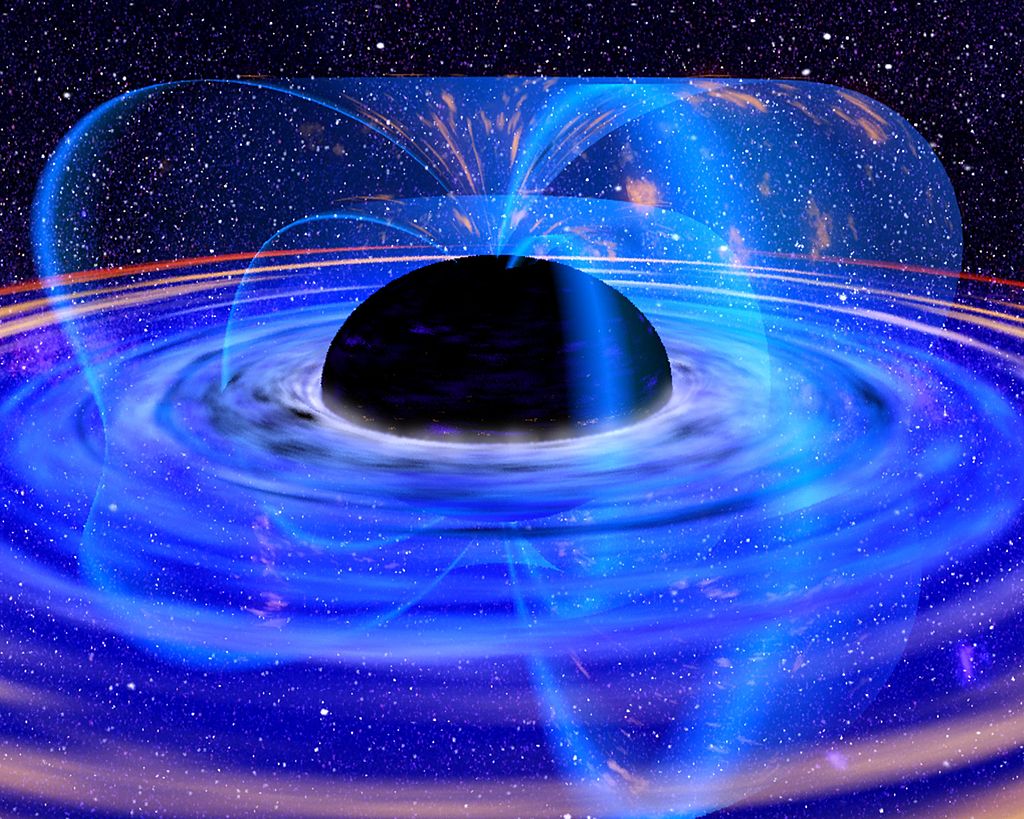
Featured Art: Black Hole Accretion Disk by XMM-Newton, ESA’s X-ray space observatory
NASA [Public domain] via Wikimedia Commons
The title for this time-traveling quantum science poem comes from St. Paul’s first letter to the Corinthians wherein he tells his new flock that for now we see as through a glass darkly. The implication is that in the future we will see clearly. Recently a couple of Dutch physicists discovered that particles at vast distances from one another can affect each other’s actions. This phenomenon, called “spooky attraction at a distance,” has implications for a strange mash-up of time and space and alternate universes.
by Jack Ramey | Jan 12, 2017 | Jack Ramey, plato, Poetry
[Poem]
Look at the light beams
pouring down from the sun:–
slicing through morning fog
and mist like a million surgeons’
carefully sharpened knives
in a medieval cathedral of medicine,
where patients wait patiently,
supine on the mossy floor of love
in the nave of, in the name of,
the greater synagogue of creation.
Just look at the dew-strewn leaves
and petals gleaming through mist:–
up-turned lips waiting to be touched
by Dawn’s rosy-fingered first
caress not unlike those aforementioned
metaphorical patients floored
by the glory of their great mother’s
lovely smile after two days
of her tears, gray rain
nourishing the roots of their being, crying
down on her children her lachrymose blessing,
her forgiveness for
those who hurt her daily
with chemical needles and warlike drones
that daily rain down their own brutal
tears on her innocent body
and the bodies of children
who one day may just stop, who already
seem to have stopped evolving
toward some greater understanding.
Look at the river valley still hugged
in fluff, puffed up with cloudy stuff
masking the flow of her borderless destiny,
her spiral world without
beginning or ending, her always
striving movement toward the sea.
[/Poem]
from Eavesdropping in Plato’s Café
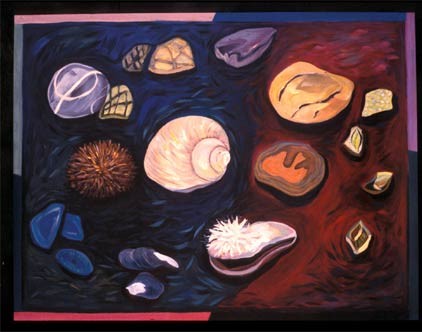
Featured Print: Found at Sea by Linda Lyke
Newfoundland Paintings: Found at Sea is from a series of paintings that convey the struggle for survival of the Beothuk Natives and European settlers of Newfoundland and memorializes the images of both cultures with their complex topography of land and sea.
by Jack Ramey | Jan 6, 2017 | Jack Ramey, Poetry
[Poem]
The world was made of black and white.
Carnivore description bears their names
written on the launching pad:
David Ghost, Astronaut.
Nathan Faltoon, pilot.
Zackadu Monguenski, bombardier.
They knew what they had to do
and they did it
all for the red, white, and blue
and the 1945 Chinese Girls Drill Team.
The Enola Gay was waiting
props up and belly heavy with death
on an airstrip not far away.
The upper right side of her fuselage
bore a new inscription:
BURNT ALMONDS it said.
David Ghost, Astronaut,
had painted it in large red letters.
Faltoon was having a drink
looking smart in the officer’s club
Dondi was lost in Europe
the Yankees were on a losing streak
and Zackadu Monguenski was jerking off
in the men’s room of Peter Wong’s Cafe G.I.
to a picture of June Lockhart
getting her family lost in space;
a photo which David Ghost, Astronaut,
had given him
in a moment of
sincere hostility.
“Hurry up boys
it’s time.”
The Enola Gay is going into labor
wants to take an atomic shit
on the world
or at least Hiroshima.
In Sweden
Albert Einstein and Werner Von Braun
disguised as
Captain Kangaroo and Mister Greenjeans
accept the Nobel Peace Prize:
“Peace cannot exist without War
Neither can tranquility without disturbance
Order without Chaos
and so it is with
humble heart
in this spirit
that I accept this
etcetera, etcetera, etcetera…”
Nathan Faltoon
stepped outside of the officer’s club
looking smart in the sunshine
which hurt his perfect ice-blue eyes
and made them squint.
He lit a Lucky Strike
took a deep drag, coughed twice
and walked across the street to
Peter Wong’s Cafe G.I.
to tear Monguenski away.
“…the only girl I ever loved…”
he was saying aloud
blubbering over the photo
in a booth by himself.
Faltoon striding over
grabs the snapshot
and rips June Lockhart to shreds.
“Get on yer feet Zack. Listen up
and listen up good.
So you loved her.
So she drove her Chevy Nova
thru a black hole.
She’s not the only bimbo lost in space
She’s not the only fish in the sea, boy,
but you’re Zack, remember?
Zackadu Monguenski, bombardier
extraordinaire
soldier of fortune
a million and one black holes
and deaths undreamed of
wait beneath your fingertips.
You’re going on this mission, pal,
cause you’re my pal,
and I’m going on this mission
cause I’m YER pal,
and pals are pals forever, see?”
Monguenski rising, moved to tears,
stunned to duty,
floating to the door in aura of ether;
he knew what he had to do.
“Let’s go burn some almonds, Duke!”
David Ghost
already in his Astronaut gear
was waiting impatiently
hopping around
on one leg
by the wing of the Enola Gay.
The great steel bird of prey
nosed open down the runway:
doom’s baby in megaton
rolling sleeplessly within her bombay womb
gathers speed,
and lifts off and up
with the ease and grace of a swan.
“Pilot to bombardier. Pilot to bombardier.
Do you read me? Over.”
Monguenski adjusting his headset:
“Roger, Duke, loud and clear.”
“Who’s the guy in the spaceman suit?”
“Oh, that’s David Ghost, Astronaut,
he’s coming along for the ride:
came into my life one night
with pictures of June Lockhart and
mumbling something about a fire
in his space ship.”
Meanwhile
a few miles below
a bunch of people
with eyes
shaped like almonds
are eating herring roe
with sticks,
drinking weak tea,
playing with their swords,
screwing on the floor
between rice-paper walls
committing Hari-Kari
and in general
thinking that life
is just dandy in Japan
for the moment.
I hear there is a big Toyota plant
in Hiroshima now
where miniature cars are picked
and sold by the thousands to weight-conscious
American shoppers.
It all makes sense
in a black and white world
when the instant of panic-zero hits
just before everything splits apart
completely:
Nathan Faltoon going thru the movements
in slow motion Mechanical Drone
Monguenski fingers his bomb-sight
David Ghost floating weightlessly
moaning: the fire the fire
the heat the pain
the renderings of charred flesh
atomic guano rain:
insane
insane
in-
sane
.
.
.
[/Poem]
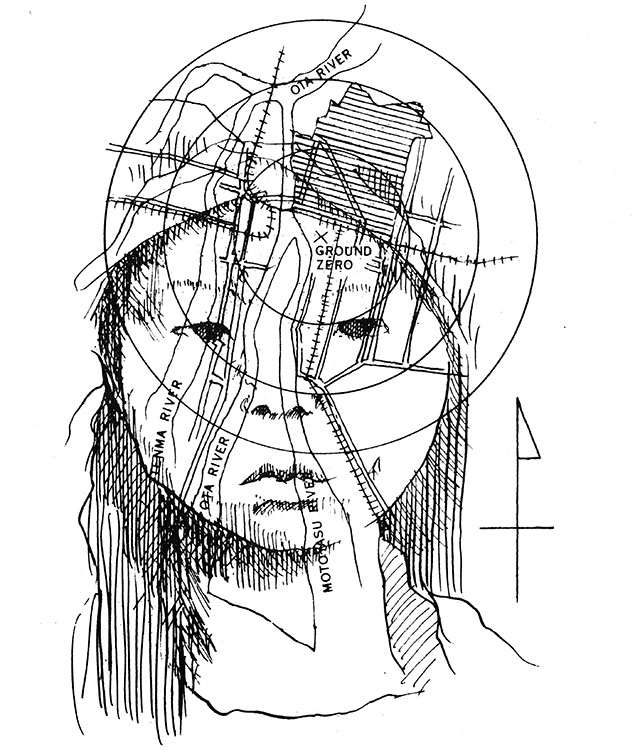
All poems are products of their own particular time. My poem, “Burnt Almonds,” is a case in point. It is a parodic, satiric, and entirely science-fictional retelling of the flight of the Enola Gay and the bombing of Hiroshima on August 6, 1945. In my mind, this act was criminal and remains one of the most horrendous examples of mass murder ever inflicted on a civilian population during a time of war. It trumps the atrocities of Genghis Khan, Tamerlane, and Adolf Hitler. Apologists for military might and right-wing war hawks inevitably maintain that American lives were saved by this act of mass murder. But the fire-bombing of Tokyo and other cities by Curtis “Bombs Away” LeMay and his henchman Robert McNamara, from their base on the former Japanese island of Guam, had already brought the empire of Japan to its knees. They no doubt would have surrendered soon without the egregious destruction of two cities and their inhabitants.
“Burnt Almonds” is as much a reaction to the Vietnam War and the rise of nuclear technology and scientism in the United States during the decade of the 1970s when I was an anti-war exile living on the island of Vancouver in British Columbia. I worked in a Japanese herring roe packing plant with my friend Jim Ryan, who gave me a cigarette case/lighter from the last “Great War,” a sort that can sometimes be seen in 1940s film noir. It belonged to someone with the initials N.F. and bore the odd inscription: With affection and gratitude from the Chinese Public School Girls Drill Team.
My associative mind was off and running, imagining a character named Nathan Faltoon who was a pilot stationed in China in the ‘40s, and then flew the Enola Gay in an alternative-history rendering of the bombing of Hiroshima. The future comes back to the past in the form of David Ghost, a merging of the souls of three astronauts who perished in a fire in their space capsule in 1967. The satirical passage towards the end depicting activities of Japanese citizens just before implosion is based on the propagandistic and stereotypical picture that many Americans had of the Japanese during the war.
“Burnt Almonds” was published as a chapbook by Shelly’s Press (Kent, Ohio) in 1978. It was the second in a series of chapbooks that have become collector’s items. The original contains marvelous illustrations by Ken Muenzenmayer and Rhonda Mitchell. It is, of course, long out of print. Ken Muenzenmayer, a fine artist, continues to paint and teach in the state of Texas.
by Jack Ramey | Mar 1, 2016 | Poetry
[Poem]
Pagans, Christians, Muslims, Jews:
You are all the sons of blood.
Worshippers of Mithras
Of Horus, of Isis, or Mars:
You are all covered in blood:
The blood of sacrificial bulls
And lambs and doves,
Crucified messiahs and saints
Lining the Appian Way
For miles (miles in Latin meaning soldier)
Soldier coming from solidus,
Those who are paid in coin
To perform certain actions
Like eliminating the target
Wasting the offal, icing
Forever the unwanted presence
Like angry Achilles dragging Hector
Behind his chariot like a piece
Of bleeding prime rib ripening
In the Trojan sun. Or Lt. Calley
And Company C in Vietnam lighting up
Some poor “gook” villagers in a ditch
In the hamlet of My Lai
In Son My village, So’n Tihn District
Beside some burning banyan trees
Napalm clinging to their limbs
And to the limbs of naked children
Running up and down burning lanes
While their few remaining loved ones
Weep and scream and keen
And pray to their ancestors
For some rational answer
To the specter of death and horror
That has curtained their lives.
Or protestors of that very same war,
Students at a Midwestern college campus
In Kent Ohio on a bright spring day
In May 1970, shot down in cold blood
Like criminals by soldiers of the state
By the orders of a mad governor
And a Chief Executive so paranoid and afraid
Of dissent that he decided to wipe it off the map.
Or jihadists beheading Christian
Spies on the drone-blasted sands of Syria,
An ancient land drowned in centuries
Of blood since Alexander and Augustus,
Or Templars burning Muslim Saracens
At the siege of Acre, red crosses on their chests
Or Arabs blowing up trainloads of Turks
With romantic Lawrence in Arabia
Or Buddhist monks lighting
Themselves up with gasoline
All the while in zazen pose
Sitting still in black and white
Still photos from 1963 or John F.
Kennedy getting his head blown off
In Dallas, red red blood staining
Jackie’s mohair dress and pill box hat
Or Harold Godwinson with an arrow in his eye
Lying on the killing fields of Hastings in 1066
Normans and Saxons,
And Vikings and Danes,
Or elephants rotting on the plains
Outside of Carthage or in the Cisalpine Alps.
My God, does this never stop?
I could go on like this until the day
I die, until the day my own blood
Stops coursing through my veins
Through my heart up to my brain
And never run out of historio-graphic examples.
Our species needs a new name.
Homo is no longer, nor has never
Been sapiens. Whose vainglorious idea
Was this to begin with? Carolus Linnaeus
That obsessive Swede. The second Adam. Did he
Really think that mankind was wise? Did he
Never lift up his eye from a microscope lens
In Uppsala and look around him, or investigate
The bloody farce of history?
We are not wise. We are violent.
Violent to the core like a hollow-point
nine millimeter parabellum round
Exploding in a third-grader’s chest
Or an AR-15 in the hands of a mild-
Mannered man in a Batman suit
spraying a crowded movie house
As if it were a penny arcade shooting
Range or a new single-shooter video game.
Homo violencia is the name I now
Propose to describe this walking,
Inventing, grasping, killing machine that now
“Peoples” the planet with greed and lust
And bloodletting red in tooth and claw
No better than the mantis with a beetle in his jaw
Or a hawk devouring a sparrow
Or a murder of crows invading a nest
Like SS Wapen smashing plate-glass
Windows in gestapo Berlin or fascist Rome
Like a pride of lions eating a living gazelle
Genitals first, up through the guts to the brain
Leaving the rest for a pack of hyenas
Or a flock of red-necked vultures to feast on.
We kill all we touch, including ourselves,
Including the earth that we live on and kill on:
In love with the violence beating in our breast,
In love with the violent gods we created.
[/Poem]
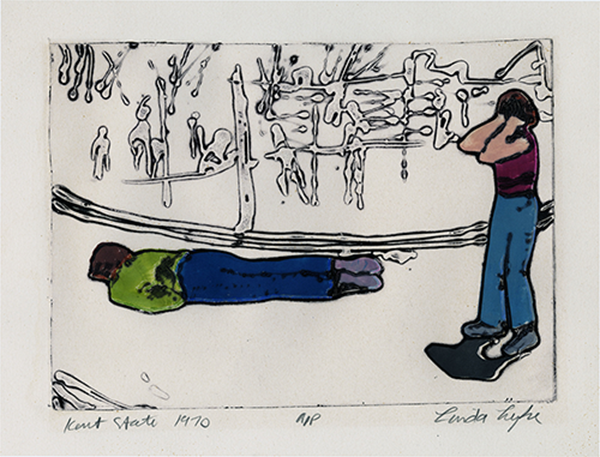
Featured Print: Kent State 1970 by Linda Lyke
Linda Lyke, a faculty member in the School of Art at Kent State in 1970, created the above print in response to the horror of the Kent State shootings.
by Jack Ramey | Feb 29, 2016 | Jack Ramey, Poetry
[Poem]
Something white floats on the water
Close to the opposite shore:
White like floating paint or a ghost
Made flesh, hanging there,
unmoved by the current.
A white plastic bag hangs high in a tree,
A vacant soul blown by a swirling wind:
Breathing in and breathing out
Like a broken balloon on a naked limb.
Whose life is this, anyway?
The loudest towboat on the Ohio
Owned by American Electric Power —
(AEP) emblazoned on the oval smoke stack
Now the fourth largest barge operator
With 1,800 barges and 45 tow boats
(Are they all as loud as this one?)
Pushes a load of rip-rap rock and gravel
Sending a loud steady groan
That echoes through the town
And up and down the long-hilled valley.
Her stern engines churn the brown water white
As she makes time, makes fast time, boys,
Past Madison to ports north and east:
Sunrise Indiana, Cin City, ship that Appalachia
Coal to Pittsburgh Pennsylvane-I-eh:
“Our barge line will move roughly 50 million
Tons of bulk commodities including cement,
Fertilizer, salt, construction materials,
Forestry products and ores along the Ohio,
Mississippi and Illinois rivers to generate
Additional revenue,” said Dwayne Hart,
Senior vice president of business
Development and strategy for AEP.
Hart would not disclose revenue or earnings,
But AEP’s recent acquisitions have been
Profitable, he said: “Wholesale investments
Including the Houston Pipe Line, the MEMCO
Barge line, the AEP coal mines, push us
“Goll-durned through the roof,” he said.
Five fires burning on the opposite shore.
Whose life is this anyway?
Down in eastern Kentucky
And western West Virginia
Descendants of the Hatfields and McCoys
Try to keep their heads above
The arsenic and mercury flood
Of thousands of acres of coal sludge:
Non-biodegradable mining byproducts
Held in ponds that periodically break loose
And come cascading down
In rivers of thick gray slurry
Creeping and burbling up
To windows and back doors
Taking over the rusty sliding boards
And bar-b-ques, the jungle gyms
Covered with slick poison slime:
“Thank God the economy is back in swing
And we’re ripping out enough coal
To make some sludge,”
Said the head of the local Environmental
Protection Agency (EPA), himself
A former mine owner.
Whose life is this anyway?
Not those folks whose houses back up to
A river of coal slurry
Whose kids are afraid to go to sleep at night
Whose property is worth zero:
Forget that catfish pole,
Young man, break it over your knee,
And the swimming hole of your youth,
Old boy: all that 1900 crap is history;
Get with the scheduled program,
Tune in to the new millennium:
You gots to live in virtual reality now
Cause real reality ain’t fit to live in —
Crawl inside your computers
All ye who can afford them
All ye who are brave enough
To march forward like soldiers
Into our brave new cybernetic world order
And lock your doors
Against the coming storm.
[/Poem]
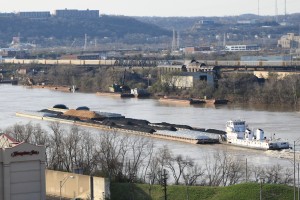
Featured Photograph: Barge pushing coal on the Ohio River
…..By Dwight Burdette (Own work) via Wikimedia Commons
…..[CC BY 3.0 (http://creativecommons.org/licenses/by/3.0)]
Related Articles:
AEP puts more emphasis on coal in revised energy portfolio forecast
America’s Top 10 Climate Change Polluters
America’s top polluter, American Electric Power, accounted for nearly 2 percent of greenhouse gas emissions in the United States — pumping out the equivalent of 130,409,118 metric tons of carbon dioxide. … The biggest dirty skeleton in American Electric Power’s closet is the little town of Cheshire, Ohio. The company inundated the town with toxic sulfurous gas clouds and acid rain after botching pollution-control technology they had implemented at the Gavin power plant.