A white plastic bag hangs high in a tree, A vacant soul blown by a swirling wind: Breathing in and breathing out Like a broken balloon on a naked limb.
Whose life is this, anyway? The loudest towboat on the Ohio Owned by American Electric Power — (AEP) emblazoned on the oval smoke stack Now the fourth largest barge operator With 1,800 barges and 45 tow boats Pushes a load of black Kentucky coal Sending a loud steady groan That echoes through the town And up and down the long-hilled valley.
Her stern engines churn the brown water white As she makes time past Madison to ports north and east: Sunrise Indiana, Cin City, ship that Appalachia Coal to Pittsburgh Pennsylvane-I-eh:
Whose life is this anyway? Down in eastern Kentucky And western West Virginia Descendants of the Hatfields and McCoys Try to keep their heads above The arsenic and mercury flood Of thousands of acres of coal sludge:
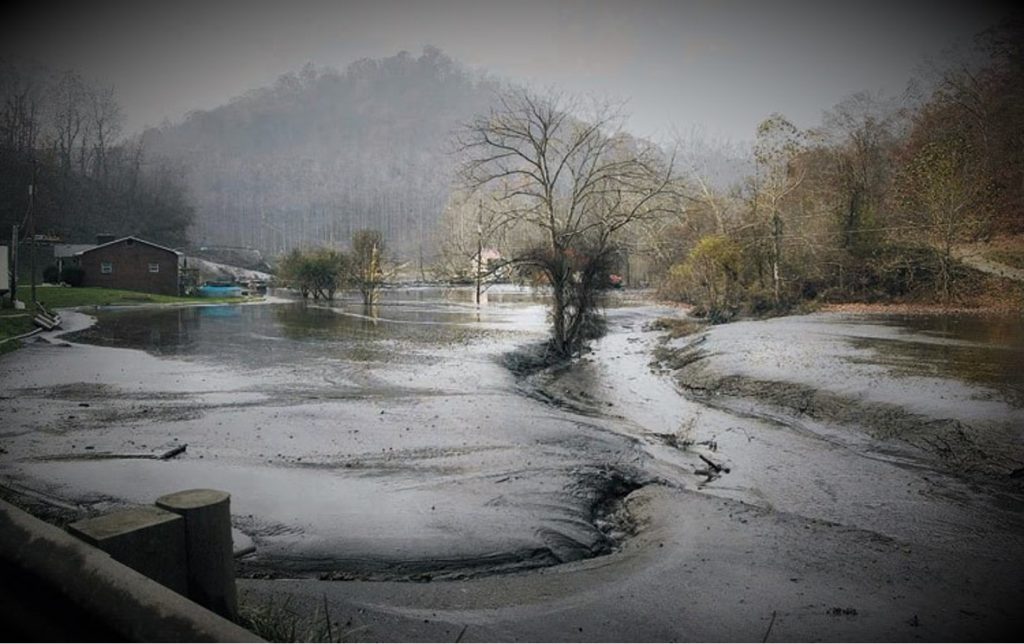
Non-biodegradable mining byproducts Held in ponds that periodically break loose And come cascading down In rivers of thick gray slurry Creeping and burbling up To windows and back doors Taking over the rusty sliding boards And bar-b-ques, the jungle gyms Covered with slick poison slime:
“Thank God the economy is back in swing And we’re ripping out enough coal To make some sludge,” Said the head of the local Environmental Protection Agency, himself A former mine owner.
Whose life is this anyway? Not those folks whose houses back up to A river of coal slurry Whose kids are afraid to go to sleep at night Whose property is worth zero: Forget that catfish pole, Young man, break it over your knee, And the swimming hole of your youth, Old boy: all that 1900s crap is history;
Get with the scheduled program, Tune in to the new millennium: You gots to live in virtual reality now Cause real reality ain’t fit to live in — Crawl inside your smartphones All ye who can afford them All ye who are brave enough To march forward like soldiers Into our brave new cybernetic world order And lock your doors Against the coming storm.
[/Poem]
Fossil fuel Power plants are one of the greatest threats to our health. At least 10 billion pounds of coal ash containing arsenic, lead and mercury is sitting on the banks of the Ohio River. In addition to a multitude of toxic air pollutants, fossil fuel power plants emit carbon dioxide, which is fueling global climate change. But instead of trying to control these emissions, Trump picked Andrew Wheeler, a prominent lobbyist for the coal industry, to head our Environmental Protection Agency so that he could protect the rich and powerful.
Louis Congo they called me when I was alive, my slave name – Louis for Louisiana, Congo for where I was taken from. Portuguese taught me to read and write but sold me off to the Frenchman who took me to New Orleans when she was young in 1721. Why they set me free to do their killing I’ll never know except they did not want to do the deeds themselves I’ll suppose.
Hung many a man both black and white, broke their limbs on the wheel if need be; flayed the skin from their backs if told to with newly knotted cat o’ nine tails.
This work got me my own house, my own gal, and all the wine I could hold. Now I am here with all the rest.
All them ghosts I sent before me come to mock me every day saying: No matter what you got, no matter where you go, no matter how well you lived, we all end up in the same place.
XXII
Homer basked himself in Cretan sun : the bright glare of light off the Mediterranean flashed the pan of his retinal scan blinding him while still young but giving him Mnemosene’s gift : Memory. Plato’s goddess sent him succor, preserved thus his lengthy line on down thru the ages by sending him sages, singers to keep his heroes alive floating ceaselessly on the wine-dark sea.
Imagine a planet where mammoths and bears outnumber people.
A mere ten thousand years ago the human population of Earth was five million bodies and souls.
You could fit them all into two Toronto Canadas.
They were pretty much the same as us except that the Sun was their God and their timepiece; the Moon was their Goddess and calendar and the revolution of the stars was their constant tablet computer.
The water-waves in their bodies lapped their bones like the tides of the sea just like they do in you and me.
They had fire like us. They had knives of flint and obsidian. They knew well how to kill sending arrows into beasts and men
stone hatchets into skulls : a great letting of blood was always with them, caressing them.
The clever ones lived by rivers; the dull ones lived by pain.
But they did not know yet how to make crops rise up from the ground.
Ten thousand years ago he or she who planted the first seeds of wild rye or barley and reaped that first harvest with jawbone sickle, started the leap toward these nine billion twenty-first century souls.
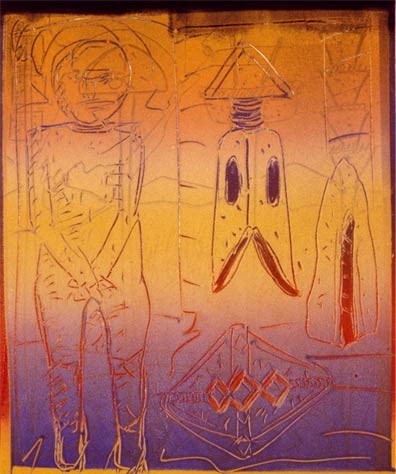
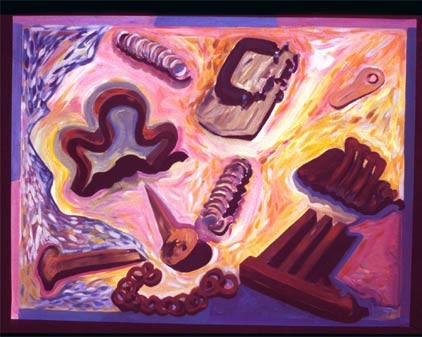
Featured Print: Burial Find by Linda Lyke Newfoundland Paintings: Burial Find is in a series of paintings that convey the struggle for survival of the Beothuk Natives and European settlers of Newfoundland and memorializes the images of both cultures with their complex topography of land and sea.
In one of his plays
Aristophanes gave him
diarrhea in Hell
and the wine god
did not strike him dead
on the spot for blasphemy.
But, it is said,
Aristophanes later died of drink.
XIII
The Romans could not
subdue the Jews
so they destroyed them –
burned Jerusalem
down to the ground
killed every man
woman and child
that they found
wandering the olive-tree wasteland
or weeping in mud huts.
Except for the Sicarii,
those Dagger Assassins
who holed up at Masala.
They killed their own women
and children and then
they killed themselves
down to the last man standing
who sliced through his own throat.
XIV
A monk rubs his tonsured head and dips his brush in Northumbrian hematite dust to paint a dragon’s face surrounding the holy logos of John.
Heathens pull their ships ashore and bang their axes against the iron bosses of limewood shields. The monk pauses, listening, his brush held up, dripping red above the page.
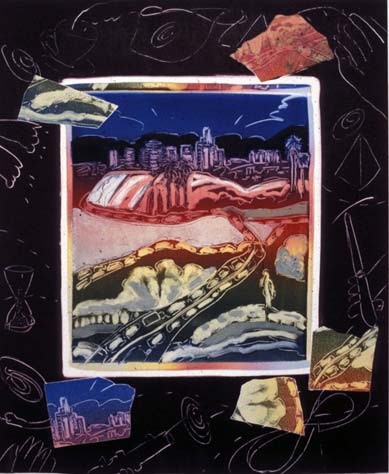
Featured Print: L.A. Fragmentation by Linda Lyke Arroyo Images: L.A. Fragmentation is from a series of prints focused on the contradiction between the densely populated areas that surround the Arroyo and its pristine isolation, illustrating a fragmenting of nature and city.
The gods are far too literal minded : Ithmonike of Pellene pregnant for three entire years after imploring the god Asklepios at Epidaurus. You silly woman, he said upon her return, why did you not say you wanted to give birth?
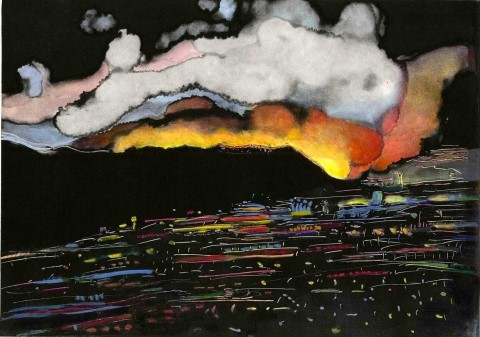
Newfoundland Paintings: Ship Wreck is from a series of paintings that convey the struggle for survival of the Beothuk Natives and European settlers of Newfoundland and memorializes the images of both cultures with their complex topography of land and sea.
No savage fit of barking
Will bring back the kiss of Eurydice.
Orpheus lies daggered in Mecca’s
Hashish clouded streets
And the calm dusty breasts of Helen
No longer sweat for the heat of cold Paris.
It is apparent ——————–(from space-walk ——————–from gaunt moon-shot)
That her old transparency is fading
Melting to a solid chemistry
Before a billion bloodshot eyes :
Mother!——–Luna divina! ————————————–Grab me
Hunt me down ——————–in your last mad seconds
Uplift me! —————–scatter me! ————————————do not fade alone.
[/Poem]
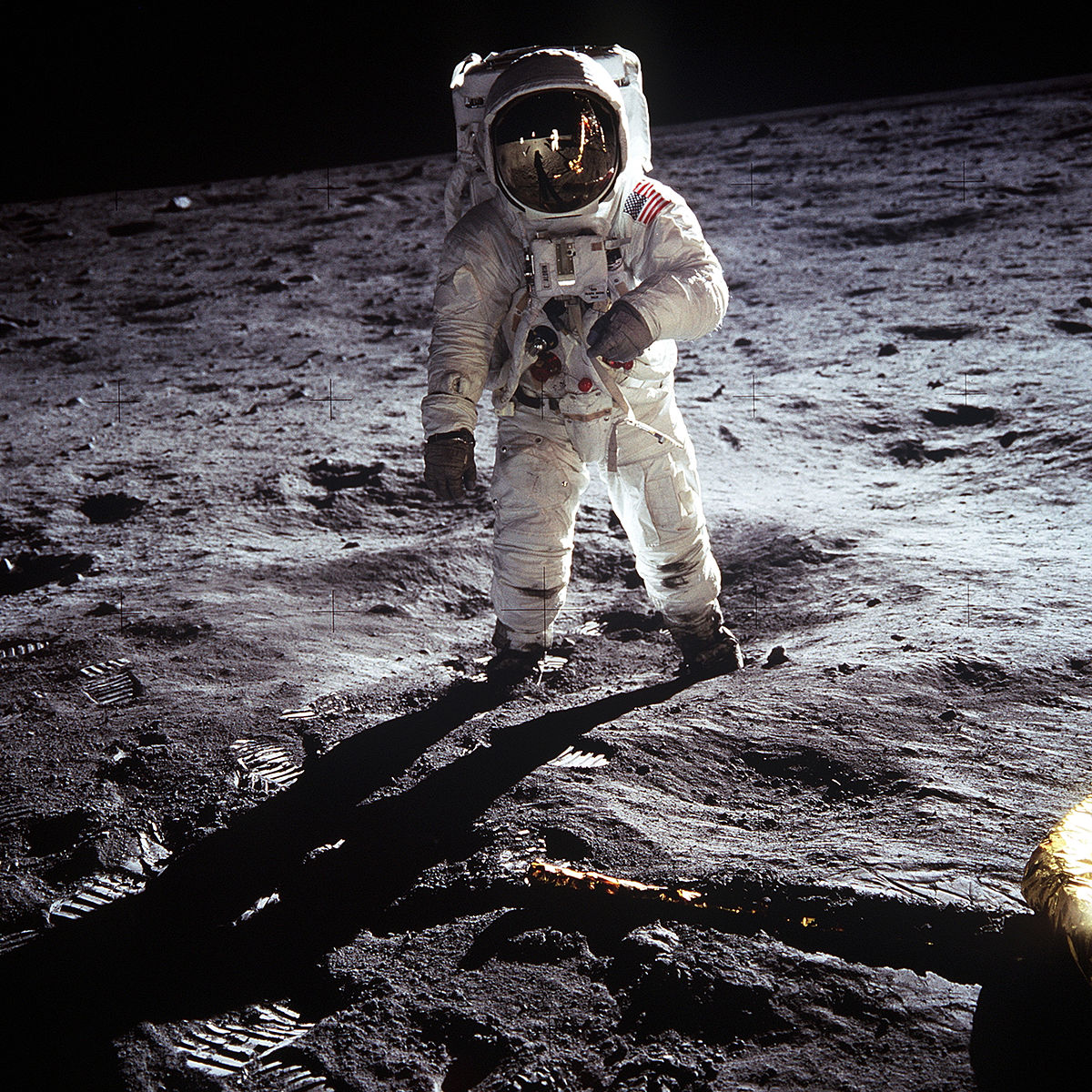
After hitchhiking across the country with my old road buddy, Dan Miller, we landed in the mecca of flower power, Haight Ashbury, on July 20, 1969. That evening we sat around a small black and white television set with a few new friends and watched as Astronauts bounced around on the surface of the moon. Unlike most Americans, I was horrified. The moon to me was sacred, a goddess, Diana/Artemis, the tripartite virgin huntress of the skies, the Triple Goddess of poetic inspiration. As I watched the Death of Myth, the triumph of technology and science over ancient pagan Earth Religion, this poem surfaced as a howl of protest against the blasphemy of techno-hegemony.
Featured Photo: Astranaut Buzz Aldrin walks on the moon, July 20, 1969.
By Neil Armstrong via Wikimedia Commons.