by Jack Ramey | Jan 27, 2021 | Jack Ramey, Poetry
 [Poem]
…………….. In Memoriam: Steven Urchek
Death is the mother of beauty
The mother of us all
Birthing us on to new journeys
Into new identities
Melding us with the Holy Spirit
The All-One Over-Soul.
And on January Twentieth 2021
A day of hope for our country
Your soul merged with the universe
And became one with the Great Mystery.
You gave your life over wholly to
Others: your caring wife, your two fine children
All the students you mentored over the years
Teaching them the history of our nation
The ideals of our democracy.
All the boys and girls, young men
And women who called you Coach
Pitching and catching and all the while
Learning how to be fair and decent human beings.
You bravely fought the uphill fight
Against an awful disease, hanging on
Refusing to give up in the bottom of the ninth
Until the final swing of the bat.
Rest in peace old friend,
my son – in law and in love –
Now you play and coach in baseball heaven
Sitting in cloud dugouts
Swapping home run strike out triple play tales
With Babe Ruth and Bob Feller; Hank Aaron
And Herb Score – taking your rightful place
In All-Star-Paradise
All watched over with loving care
By the precious and holy grace of God.
[/Poem]
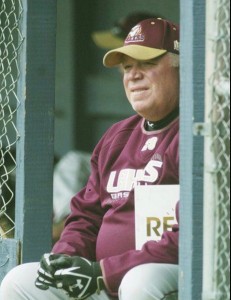
Urchek remembered for impact he had on so many lives – by Mike Shaffer
by Jack Ramey | Aug 6, 2020 | Jack Ramey, Poetry
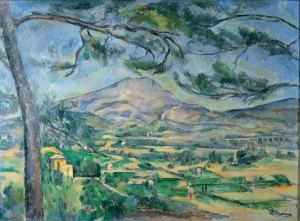
……..Mont Sainte-Victoire, Provence
Marc and Anne-Marie
live in the shadow of the Marquis
de Sade’s chateau between
Le Coste and Coustellet
in the hot magic of Provence.
They live like children of wonder
who have no past or future
who laugh at everything
and sing secret songs to the sun.
They make large French furniture
which they sell to tourists;
they call their baker mother;
they linger over dinner
long hours into the night
and only drink the light
red wine made by their neighbors.
There is a place you must see,
says Anne-Marie. C’est un secret,
un mystère, and she leads me
off the dusty road
through a tangle of lavender
and jenever bushes whose berries
smell like gin to a clearing
where an old stone building stands.
Round narrow closed gazebo
made of flat stacked stone
looking like a turret plucked
from a wild castle. Voila! Ici.
What is it, I ask.
Je ne c’est pas. No one knows.
They say it is old. Vraimont ancien.
Inside, two small chambers,
hard clay floors, a fortress for dwarfs
perhaps or a place where
the Romans put you when you laughed
instead of bowing low to Caesar.
But some say it is the place
where the secret names of the gods are kept.
The ancient gods, gods
of this place, the gods of the Luberon
before Jupiter before Jesus
god of Vaucluse, cold flowing goddess
of Ils-sur-le-Sorgue
goddess of vine and grain
and the white old man of Ventoux.
And all around us
outside in the still shivering heat
a chorus of insistent
cicadas, les cigales,
the keepers,
cling to the trees
and chant and repeat
and sing the secret they
overheard dark ages ago,
the unknowable, forgotten names of god.
[/Poem]
Featured Art: Mont Sainte-Victoire by Paul Cézanne via Wikimedia Commons
Related Article: How Provence Changed the World of Art
by Barbara Noe Kennedy
“It was all thanks to the revolutionary genius of Aix-en-Provence native Paul Cézanne. On the edge of the quintessential Provençal town of Aix-en-Provence, Mont Ste-Victoire soars more than 1,000m above a vast plain of vineyards, red tile-roofed villages, meandering streams and copses of pines. . . . The Romans achieved their first significant stronghold beyond their empire at this very spot, defeating Cimbrian and Teutonic barbarians in 102 BC. Legend dictates the name Mont Ste-Victoire (Mount Saint Victory in English) has memorialized that win ever since (the ‘saint’ was added by medieval Christians).”
by Jack Ramey | Jan 11, 2019 | Jack Ramey, Poetry
.
[Poem]
The Iroquois called you O-he-O,
the Wyandot the Oheezo,
which some took to mean “sparkling,”
others “white,” while the French
took it to mean “beautiful” :–
La Belle Rivière, the beautiful river
they called you and they were right,
at times you are white,
at times you sparkle
like diamonds in the sun,
and you are always beautiful
in all your moods – muddy brown
from spring rains, or placidly green,
silver flowing water,
bringing life and death
to all who live and grow
beside your thousand mile length
three centuries ago or today
cascading down from Allegheny
and Monongahela confluence
sliding by stone age huts
and Adena conical burial mounds
high up on hills and always bloody,
bloody throughout your mythic history
of discovery, war, and conquest.
Twenty-first century versions
of those same huts
still on the same hills,
or perilously hugging your banks
which sometimes you overflow
north and south flooding
their dirty basements
just to show them they might
be a bit too close: back off, you say,
give me some elbow room,
some space to change my course
as you wend your way
down to meet the stuttering
Mississippi, and so on down to dark
and broken New Orleans
where you spread yourself out
upon the vastness of the deep.
[/Poem]
<br>
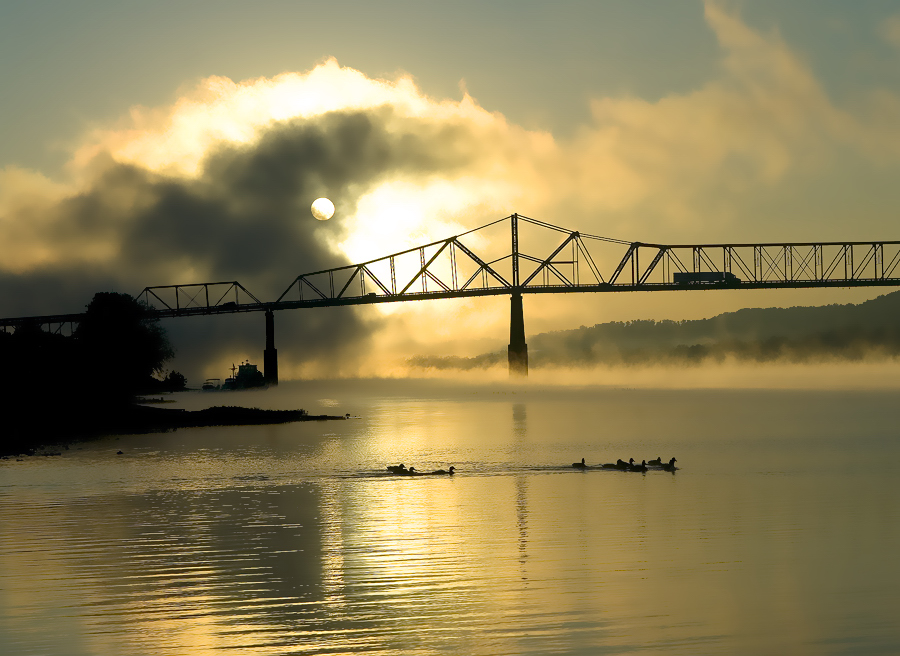
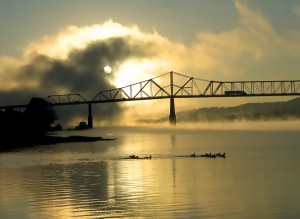
As a poet, I am fascinated by the metaphysical, mystical, and metaphorical nature of rivers in general and the Ohio River at Madison in particular. From my home, high on a hill overlooking the Ohio River and downtown Madison, I am able to experience the daily changes in the relationships and moods of the river. Our lives are rivers of events and encounters, floods and lulls, twists and turns in the journey to the one-time drop-less sea of eternity.
Featured Photograph: Ohio River Sunrise by Bernie Kasper
by Jack Ramey | Jan 10, 2019 | Jack Ramey, Poetry
.
[Poem]
1.
A great bronze god
This morning
Swollen and muddy,
Slowly silting down,
Muscles rippling like some
Giant water stallion,
Moving past Broadway, past Elm
Past the geese at the floating marina
Past the stacks of the monolithic power plant
Past all the bare and sunken trees
To list round the bend at Hanover,
Moving his way on down to Louisville,
New Albany, Evansville, Memphis, Cairo, Mississippi!
Carrying the weight of thousands of lives.
The dead are with him as well as the living:
Dead logs and dead bones,
The ghosts of those who perished in his flood
In their perilous leap toward freedom,
Ferried long ago from Milton’s shore
Or Indian Kentuck by reckless boatmen,
Indiana Charons rowing their dark
breathing freight
to Elysium.
2.
The beginnings and endings
Of all things tucked
Within your liquid furrows,
Your deep rollings,
As church bells toll you
On your cyclic way
to a shared oblivion:
Hart Crane’s great wink of eternity,
Whitman’s mighty I-am-Thou
Shine with the sun
On your burnished surface
Issuing forth vague promise
Of some hidden covenant to come,
Some secret bargain
With forces unknown;
And one day all will be revealed
As the prophet saith
When the weight of all this water
Unseen and teeming
With life and death
Comes at last to rest
In the dropless one-time silent sea.
.
[/Poem]
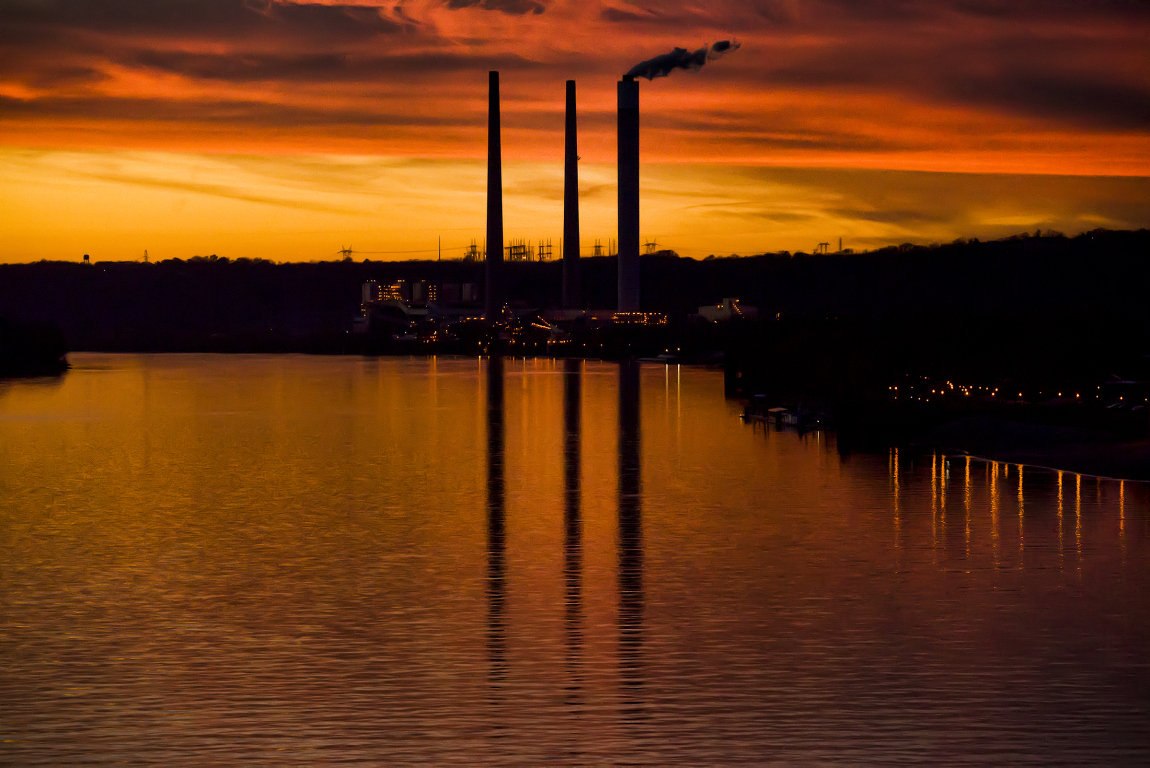
As a poet, I am fascinated by the metaphysical, mystical, and metaphorical nature of rivers in general and the Ohio River at Madison in particular. From my home, high on a hill overlooking the Ohio River and downtown Madison, I am able to experience the daily changes in the relationships and moods of the river. Our lives are rivers of events and encounters, floods and lulls, twists and turns on the way to the one-time drop-less sea of eternity.
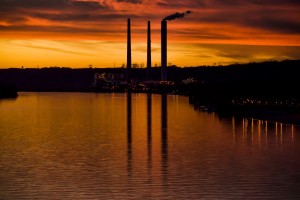
Featured Photograph: Indiana Sunset by Bernie Kasper
Walking the bridge has become the new pastime for many downtown Madison Indiana residents. It is a photographer’s dream location with so many fascinating subjects you are able to capture, from the power plant to the barges and boats that navigate the river below. — Bernie Kasper
by Jack Ramey | Dec 31, 2018 | Jack Ramey, Poetry
[Poem]
………………..- .– for the corporate heads of Honeywell
Hiawatha combed the snakes
From the mind, preparing the way.
Preparing the way for Tadadaho,
Keeper of the fire of the One United
Longhouse of the Haudenosaunee,
The people of the longhouse, who
Keep the flames burning
By the shores of Onondaga Lake
Where the Tree of Peace was planted
Long ago and the weapons of war
Were cast into the abyss
To be washed away forever.
But forever is much too long a time,
And the weapons of war
Have changed. And the snakes have returned
In factories. War clubs and tomahawks
Replaced now by sodium chloride
And ash byproduct and god knows what
Other chemicals dumped
Into the holy lake by corporate enemies
Of the earth:
Raping our mother with
No regard for the future generations:
The unborn faces in the ground,
The ground now filled with filth.
The pure silver lake is now a cesspool
Of mercury and feces: one of the most polluted
Lakes in America, where effluent
From a waste plant flows unimpeded into it.
No swimming allowed. But poor blacks
And hungry immigrants still fish
Her fouled waters and sicken from the catch.
The place chosen for the continuity
Of rational existence, of how to be a true
Human being walking the ways of the Creator
In the days before colonial greed
Is now the most polluted place in Iroquoia,
Now called Syracuse New York
Where once crystal waters brimmed with fish,
Place for deer and beaver to drink,
Place for the people to drink, now unfit for creation
Making a mockery of the Great Mysterious’ plan.
[/Poem]
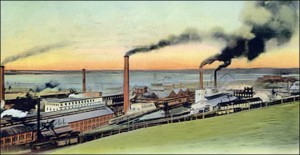
Featured Art: 1900 postcard of Solvay Process Company on Onondaga Lake via Wikimedia Commons
When I was given a tour of the Great Law of Peace Center on Onondaga Lake by its director, Dr. Philip Arnold, and Sandy Bigtree, I was shocked to learn that the sacred Onondaga Lake, which is the setting for the beginning and ending of my historical novel Turtle Island: A Dream of Peace, is the most polluted lake in America. Most every spiritual faith has its sacred sites and Onondaga Lake is one of the four sacred sites of the League of Six Nations, which is composed of the Onondaga, Mohawk, Seneca, Oneida, Cayuga, and Tuscarora Nations.
Centuries before the Europeans invaded Turtle Island, which is how indigenous people perceive the continent of North America, five nations were caught up in a cycle of bloody revenge wars until a holy man, the Great Peacemaker, showed them the path to peace. And they met on the banks of Onondaga Lake and agreed to bury their weapons, planted the Great Tree of Peace on the bank of Onondaga Lake, and formed the Haudenosaunee Confederacy, which was the first democracy on the American continent.
In colonial times, the French called them the Iroquois and the English called them the Six Nations. The Haudenosaunee Constitution, which emerged from the historic gathering on Onondaga Lake, had a tremendous influence on the colonists, and some say that what made the colonists and our Founding Fathers pull away from their English roots and become Americans with their concept of liberty and justice for all were the principles used by the League of Six Nations formed at Onondaga Lake.
How did Onondaga Lake, which should be a sacred site to Americans as well as Native Americans, become so polluted? It began in the 19th century when Ernest Solvay, a Belgian chemist, developed a chemical process to produce soda ash from brine. He built his first factory to use his new method in 1863 in Belgium. A clever industrialist, he expanded rapidly and opened new factories in Europe. In 1881, Mr. Solvay incorporated the Solvay Process Company on the southern end of Onondaga Lake. They produced around 20 tons of soda ash per day, and to maximize profits, they dumped most of its waste material directly into the sacred Onondaga Lake.
In 1920, they merged with four other chemical companies, forming Allied Chemical and Dye Corporation. They dropped the Solvay name, probably because they had been threatened with lawsuits over their reckless pollution of Onondaga Lake by the New York State Attorney General. Under their new name, they began using mercury to produce chlorine. They dumped around 25 pounds of mercury per day into Onondaga Lake until the fish became toxic and the government had to ban all fishing and swimming in 1970.
In 1985, they morphed their name again to AlliedSignal. Their current name, Honeywell International Inc, is the product of a merger in which AlliedSignal acquired the much smaller Honeywell Inc. Even though it was smaller, they claim they chose the Honeywell name because of its superior brand recognition. However, the real reason may have been to cover up their destruction of the sacred Onondaga Lake.
This year Honeywell was ranked 75th in the Fortune 500, yet they still refuse to clean up all the mercury they dumped into Onondaga Lake, insisting that it is safe to leave a significant amount on the bottom. You may want to boycott all Honeywell products until they assume their responsibility as an ethical company and clean up the toxic waste they left behind. The health of our environment, our spiritual landscape, our historical heritage, our people, and future generations is far more important than the Honeywell profits for the rich.
by Jack Ramey | Dec 9, 2018 | Poetry
[Poem]
Barely contained laughter
slicing open the heart of the matter
exposing the irony or hypocrisy
of all our tendentious moments
here on this long wave
we’ve been riding for half a century.
Jack, I see you now in old man’s
shoes, a linen suit, a straw boater
and a bright red jazz bow tie
dancing with diaphanous Paula
on the hard wood wedding floor
dreaming of Morocco’s hashish crowded
streets, or the horses you trained
in Maine, or all the great friends
you made and loved in Kent
and Youngstown and Cleveland
and all over the world
too many to mention and who loved
you back for being true to art
and true to humanity
and for giving much more than you took.
[/Poem]
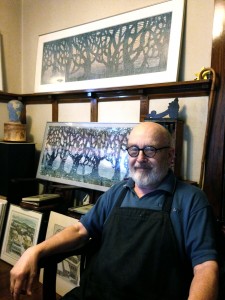
Featured Art: Jack Carlton’s Observations & Impressions, The Morgan Art of Papermaking Conservatory
The Vindicator: Jack Carlton’s story unfolds like his art. Shaped and layered with rich and varied experiences that inform his work with images, languages, and methods that became entirely his own. He was a vagabond at heart. Traveling from one place, one medium, one idea to another throughout much of his illustrious career. He lived and worked in Morocco, parts of Maine, Ohio, and the city of Boston, with short stays in New York City, in between, while making, teaching, and selling art to move on to the next place he should be. Carlton exhibited extensively throughout these regions and beyond, finding places for his work in public and private collections in the United States, Europe, and North Africa. He was commissioned by the Vietnamese architect to King Hussein II to portray the Mausoleum of the King’s father, taught Art and English overseas, and created outdoor exhibitions in galleries and neighborhoods across the world. He earned his sculpture and painting degrees from Kent State University and a MFA in printmaking from the School of the Boston Museum of Fine Arts and Tufts University.
Carlton described his work as a response to the changing world around him, a personal diary of what he was thinking about or what was happening in the world today, tomorrow and yesterday. “ I work out ideas in sculpture, painting, printmaking and artist books,” he said. Often produced in series, many of these works were premised by social issues, current events, and political activism, touching the artist in some way. While Carlton settled into older age in Girard, his approach to art-making still wandered like a young man pursuing a dream. There will be a celebration of Jack Carlton’s life held at Dorian Books in Youngstown on Sunday, Dec. 9, at 2 p.m.