My heart aches, and a drowsy numbness pains ….My sense, as though of hemlock I had drunk,
Or emptied some dull opiate to the drains ….One minute past, and Lethe-wards had sunk:
‘Tis not through envy of thy happy lot, ….But being too happy in thine happiness, — ……..That thou, light-wingèd Dryad of the trees, ……………..In some melodious plot ….Of beechen green, and shadows numberless, ……..Singest of summer in full-throated ease.
O for a draught of vintage! that hath been ….Cool’d a long age in the deep-delvèd earth,
Tasting of Flora and the country-green, ….Dance, and Provençal song, and sunburnt mirth!
O for a beaker full of the warm South! ….Full of the true, the blushful Hippocrene, ……..With beaded bubbles winking at the brim, ……………..And purple-stainèd mouth; ….That I might drink, and leave the world unseen, ……..And with thee fade away into the forest dim:
Fade far away, dissolve, and quite forget ….What thou among the leaves hast never known,
The weariness, the fever, and the fret ….Here, where men sit and hear each other groan;
Where palsy shakes a few, sad, last grey hairs, ….Where youth grows pale, and spectre-thin, and dies; ……..Where but to think is to be full of sorrow ……………..And leaden-eyed despairs; ….Where beauty cannot keep her lustrous eyes, ……..Or new Love pine at them beyond to-morrow.
Away! away! for I will fly to thee, ….Not charioted by Bacchus and his pards,
But on the viewless wings of Poesy, ….Though the dull brain perplexes and retards:
Already with thee! tender is the night, ….And haply the Queen-Moon is on her throne, ……..Cluster’d around by all her starry Fays ……………..But here there is no light, ….Save what from heaven is with the breezes blown ……..Through verdurous glooms and winding mossy ways.
I cannot see what flowers are at my feet, ….Nor what soft incense hangs upon the boughs,
But, in embalmèd darkness, guess each sweet ….Wherewith the seasonable month endows
The grass, the thicket, and the fruit-tree wild; ….White hawthorn, and the pastoral eglantine; ……..Fast-fading violets cover’d up in leaves; ……………..And mid-May’s eldest child, ….The coming musk-rose, full of dewy wine, ……..The murmurous haunt of flies on summer eves.
Darkling I listen; and, for many a time ….I have been half in love with easeful Death,
Call’d him soft names in many a musèd rhyme, ….To take into the air my quiet breath;
Now more than ever seems it rich to die, ….To cease upon the midnight with no pain, ……..While thou art pouring forth thy soul abroad ……………..In such an ecstasy! ….Still wouldst thou sing, and I have ears in vain— ……..To thy high requiem become a sod.
Thou wast not born for death, immortal Bird! ….No hungry generations tread thee down;
The voice I hear this passing night was heard .>..In ancient days by emperor and clown:
Perhaps the self-same song that found a path …..Through the sad heart of Ruth, when, sick for home, ……..She stood in tears amid the alien corn; ……………..The same that ofttimes hath ….Charm’d magic casements, opening on the foam ……..Of perilous seas, in faery lands forlorn.
Forlorn! the very word is like a bell ….To toll me back from thee to my sole self!
Adieu! the fancy cannot cheat so well ….As she is famed to do, deceiving elf.
Adieu! adieu! thy plaintive anthem fades ….Past the near meadows, over the still stream, ……..Up the hill-side; and now ’tis buried deep ……………..In the next valley-glades: ….Was it a vision, or a waking dream? ……..Fled is that music:—do I wake or sleep?
Jack Ramey talks about John Keats and reads Ode to a Nightingale.
John Keats, born on October 31, 1795, is the quintessential Romantic poet. He was not well regarded during his brief lifetime, but now, more than two hundred years after his birth, his small output of poems are considered some of the most beautiful and beloved in the English language. Two years ago, I stood on the very ground, Wentworth Place in Hampstead (now the Keats House Museum), where Keats composed his famous Ode to a Nightingale, one of the most moving poems ever written.
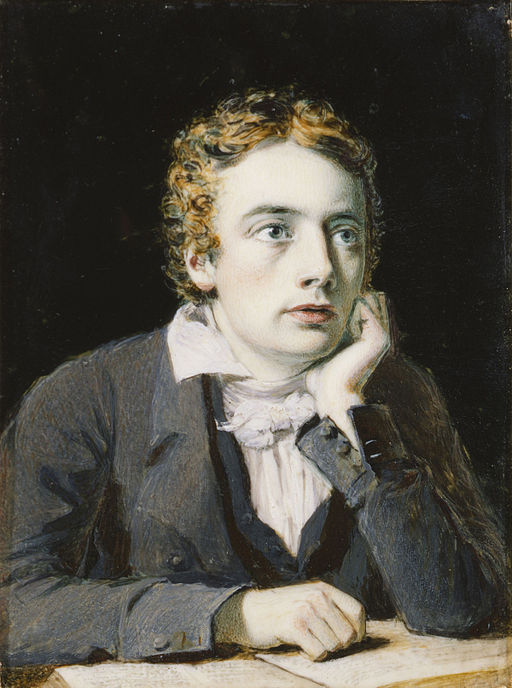
His good and loyal friend, the artist, Joseph Severn, painted the portrait shown above. When Keats contracted tuberculosis, Severn went with Keats to Rome, nursing him until the end. He died of tuberculosis in Rome at the age of 25 convinced that his work would be forgotten. He requested that no name or date be written on his tombstone, only the inscription: “Here lies One whose Name was writ in Water.”
Painting of John Keats by Joseph Severn (1793–1879), via Wikimedia Commons
Thou still unravish’d bride of quietness, …..Thou foster-child of silence and slow time,
Sylvan historian, who canst thus express …..A flowery tale more sweetly than our rhyme:
What leaf-fring’d legend haunts about thy shape …..Of deities or mortals, or of both, …..In Tempe or the dales of Arcady?
What men or gods are these? What maidens loth? …..What mad pursuit? What struggle to escape? ……….What pipes and timbrels? What wild ecstasy?
Heard melodies are sweet, but those unheard …..Are sweeter; therefore, ye soft pipes, play on;
Not to the sensual ear, but, more endear’d, …..Pipe to the spirit ditties of no tone:
Fair youth, beneath the trees, thou canst not leave …..Thy song, nor ever can those trees be bare; …..Bold Lover, never, never canst thou kiss,
Though winning near the goal yet, do not grieve; …..She cannot fade, though thou hast not thy bliss, …..…..For ever wilt thou love, and she be fair!
Ah, happy, happy boughs! that cannot shed …..Your leaves, nor ever bid the Spring adieu;
And, happy melodist, unwearied, …..For ever piping songs for ever new;
More happy love! more happy, happy love! …..For ever warm and still to be enjoy’d, …..For ever panting, and for ever young;
All breathing human passion far above, …..That leaves a heart high-sorrowful and cloy’d, …..…..A burning forehead, and a parching tongue.
Who are these coming to the sacrifice? …..To what green altar, O mysterious priest,
Lead’st thou that heifer lowing at the skies, …..And all her silken flanks with garlands drest?
What little town by river or sea shore, …..Or mountain-built with peaceful citadel, …..Is emptied of this folk, this pious morn?
And, little town, thy streets for evermore …..Will silent be; and not a soul to tell …..…..Why thou art desolate, can e’er return.
O Attic shape! Fair attitude! with brede …..Of marble men and maidens overwrought,
With forest branches and the trodden weed; …..Thou, silent form, dost tease us out of thought
As doth eternity: Cold Pastoral! …..When old age shall this generation waste, …..Thou shalt remain, in midst of other woe
Than ours, a friend to man, to whom thou say’st, …..“Beauty is truth, truth beauty,—that is all …..…..Ye know on earth, and all ye need to know.”
[/Poem]
Jack Ramey talks about John Keats and reads Ode on a Grecian Urn.
.
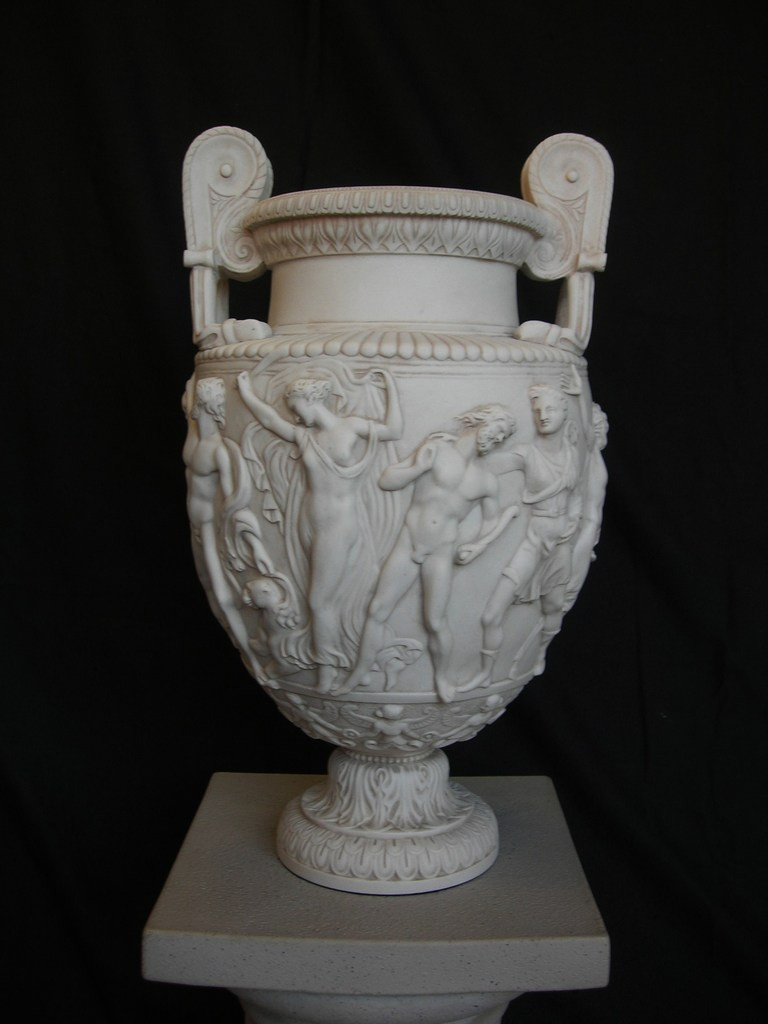
Some say that Keats was inspired to write his Ode on a Grecian Urn after seeing the Elgin Marbles in the British Museum. Others maintain it was the Townley Vase that fired his imagination. Neither of these objects, however, contain the wealth of detail that exists in the poem.
In it, the poet contemplates the eternal nature of art and the fleeting nature of life. He relates a scene where an ancient village empties itself out and its citizens walk to a pagan sacrifice accompanied by pipes and drums and wild ecstasy. A lover tries to kiss a maiden who is “loath” to accept his advances on this pious morn. She will never be his, but she will always be young and desirable. Art and beauty passed down through the ages trump reality, Keats seems to say, by being forever unchanging, forever young, forever new.
When I was in London two summers ago, I tried to see the Townley Vase at the British Museum, but it was not on display, kept in a locked room in the basement, available only through prearranged appointment. But I did spend time with the Elgin marbles and their scenes of sacrifice infamously ripped off the façade of the Parthenon in Athens by Lord Elgin, an act of looting famously condemned by Lord Byron and the Greek government. Keats’s famous last lines of the Ode still resonate and acted for me as a poetic voiceover to the Elgin marbles: ”Beauty is truth, truth beauty. That is all ye know on earth and all ye need to know.”
Lay me down in cool salt water.
Lay me down like Noah’s daughter.
Lay me down and tell me you miss me.
Lay me down when I’m dead, and kiss me.
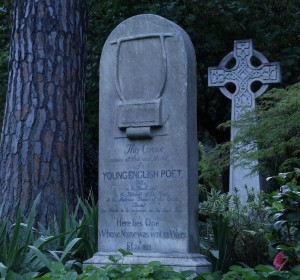
In the non-Catholic cemetery in Rome
Close by the pyramid of Cestius
The bones of John Keats lay down in cool
Earth. His words were not writ on water
As it says on his stone, his last request.
Green leaves of ground-cover fill the grave :–
This now resurgent life of his remains. But his
Real remains are writ upon the winds of eternity
Sung over and over lo these last two hundred years
And will be as long as English poetry is remembered.
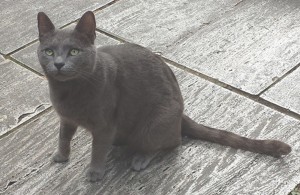
A small gray cat circles my calves and lays
Him down by Keats’ grave. These cats, some say,
Are the ghosts of those buried here, and they
Lay upon the stones and plots as if protecting them
From daemons who would steal their souls or
Their legacies. This gray stays. Is protective.
Abides like all-abiding Death. Makes his bed now
Upon the tripod’s canvas case as I recite for camera
And for “the darkling” the great Ode to a Nightingale
And caress with my finger tips the green grass
Of Keats’ hair as my tears water the soil of his long-
Gone longing for death and the bliss of final solitude.


 John Keats, born on October 31, 1795, is the quintessential Romantic poet. He was not well regarded during his brief lifetime, but now, more than two hundred years after his birth, his small output of poems are considered some of the most beautiful and beloved in the English language. Two years ago, I stood on the very ground, Wentworth Place in Hampstead (now the Keats House Museum), where Keats composed his famous Ode to a Nightingale, one of the most moving poems ever written.