
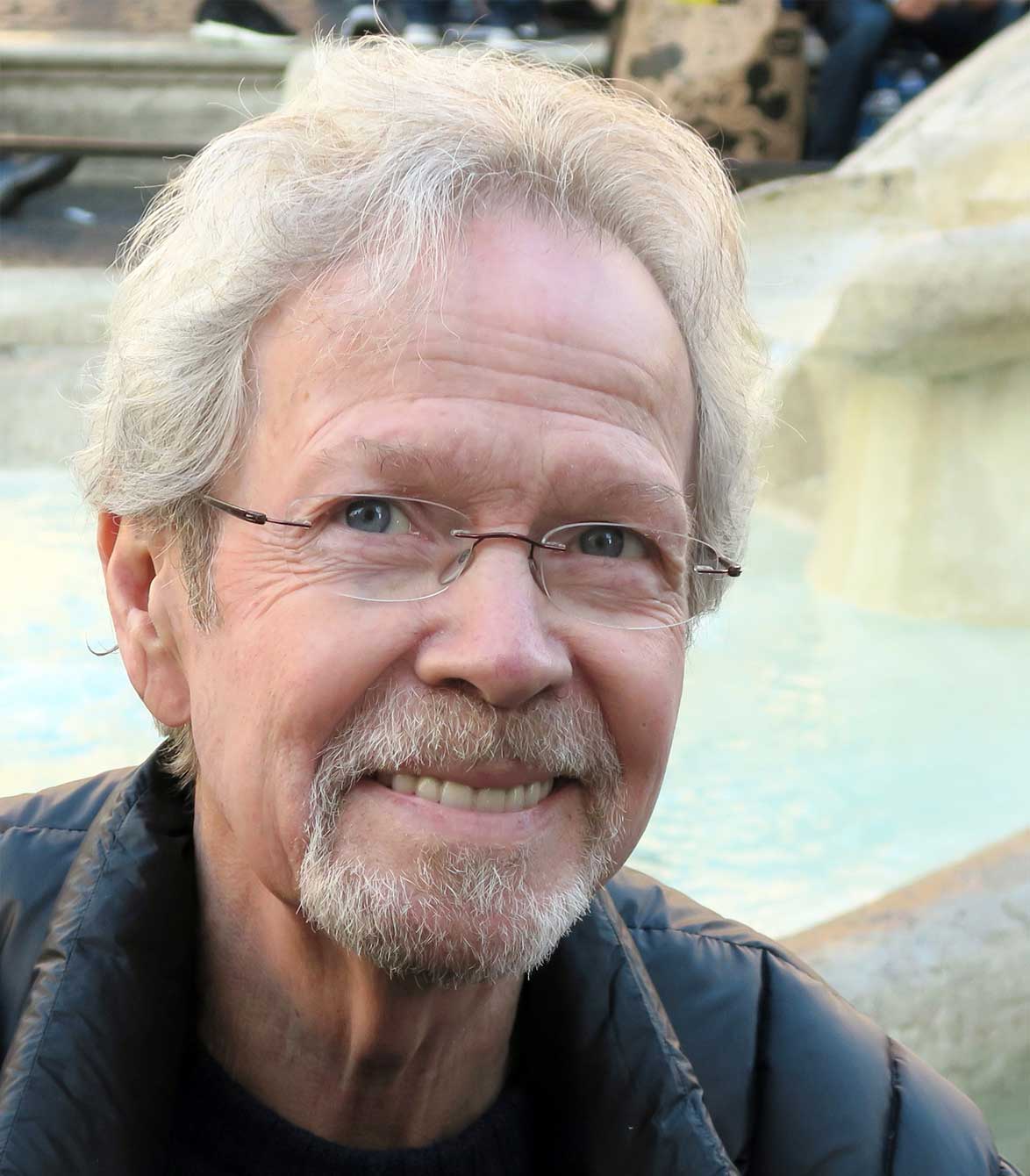
Jack Ramey was a poet, author, performer, and former chair of the English Department at Indiana University SE, where he taught creative writing and literature. Jack is the co-author of the highly acclaimed children’s picture book Stevie and Vincent: A Passion for Color.
His documentary Ecstasy & Death: Keats and Shelley in Rome received awards and recognition from several international film festivals. His documentary, William Blake: Inspiration and Vision, won an Aegis award for best educational film. Keats and Shelley in Italy features Jack reading at the Keats-Shelley House in Rome.
The poems, videos, readings, and audios featured on the Springwood Press website are Jack’s work. His videos include Ode to the West Wind, Ode on a Grecian Urn, and Ode to a Nightingale. His poetry books include The Future Past, Death Sings in the Choir of Light, and Eavesdropping in Plato’s Café. His historical fiction, Turtle Island: A Dream of Peace, tells the story of the founding of the Iroquois League of Nations.
Jack was also the author of academic works including Transcending Gender: Toward a New Awareness of the Fluid Self in Writing and The Coffee Planter of St. Domingo: A Technical Manual for the Caribbean Slave Owner, which examines the rhetoric of racism.
Jack played the lead role in the film The Age of Insects, which was screened and archived at the Museum of Modern Art as part of their exhibit Club 57: Film, Performance, and Art in the East Village, 1978–1983. He also created Environmental Art on the Ohio River with nature photographer Bernie Kasper, a program which celebrated the beauty of nature and the great threats it is facing.
In his early years, Jack studied to be a priest at the Passionist Fathers Seminary, then became a part of the counterculture and read his poetry in Santa Cruz, San Francisco, Eugene, Victoria BC, and Kent OH. He then moved to Manhattan to work in the theater.
His one-person show Dark Is a Long Way: An Evening with Dylan Thomas ran for two years at the 13th Street Theater in New York, at the Odyssey Theater in Los Angeles, and toured the country. Among his New York stage roles was Bunthorne in Gilbert and Sullivan’s Patience. Isaac Asimov, a G&S buff, praised his performance as “the best Bunthorne I have ever seen.”
Jack later taught in Stockholm for several years. After returning to America, he performed in medieval plays with the Chicago Medieval Players and often read his poetry at the Green Mill, where he was a finalist in the Chicago Slam.
Throughout his life, Jack brought together poetry, literature, theater, film, and a deep concern for the natural world. The following Author Statement was written by Jack about his poetry and the ideas that shaped his work.
Eavesdropping in Plato’s Café is a collection of lyrical, elegiac, and dramatic poems that are at once philosophical and personal, encompassing the broad sweep of history from ancient Greece to post-millennial America. The title poem and others in the collection touch on the intellectual and aesthetic history of the West, while others trace a highly personal spiritual evolution incorporating both eastern and western spiritual thought. The poems, both the long ones and the shorter lyrics, are filtered through an understanding that we as human beings are all temporal creatures striving toward some understanding of why we are here and where we are going. They speak through a highly charged musical idiom that touches the intellect as well as the heart.
As a student of anthropology at Kent State, I wrote a paper on Lewis H. Morgan’s League of the Ho-de-no-sau-nee or Iroquois. Since then I have continued a lifelong fascination with the People of the Longhouse, which led to the creation of Turtle Island: A Dream of Peace.
Because of the troubling times in which we live, I feel that it is a poet’s duty to use the power of poetic language to speak out against inhumane behavior with the hope that it will move and inspire those with similar views and help transform those who may have different opinions.